Roadmap towards climate neutrality in 2035
If we want to leave future generations a liveable planet, we have to take action now to prevent the earth from warming up by more than 1.5°C.
Eneco is taking its responsibility. Together with customers, we want to be climate neutral by 2035. To this end, we focus on three actions: decarbonise our customers, generate more sustainable energy en balance and optimise the energy system.

Accelerating efforts
According to the Intergovernmental Panel on Climate Change (IPCC, 2021), at the current rate of global warming we will reach 1.5°C around 2030. Without strengthening current policies, the global temperature increase is projected to rise to about 3.2°C by 2100 (IPCC, 2022). If temperatures continue to rise, the frequency and intensity of heat waves, extreme precipitation and droughts will increase and serious effects on ecosystems, plants, animals and people can no longer be avoided.
Current efforts by the energy sector to reduce greenhouse gas emissions to zero by 2050 are no longer sufficient. The International Energy Agency (IEA) announced in 2021 that the electricity sector in developed countries needs to achieve 'net zero' emissions as early as 2035 in order to limit global warming to 1.5°C.
Eneco and customers climate neutral by 2035
Eneco is taking responsibility for this and is accelerating its existing ambition to become climate neutral by 15 years to 2035.
"We have the ambition to be climate neutral as early as 2035. Not only in our own activities, but also in the energy we supply to our customers."
We are going faster than the scientifically substantiated 1.5°C path prescribes. We have chosen to do this because it seems possible to reduce our emissions more quickly and to stay below the 1.5°C path in the event of any setbacks to our reduction efforts. We also want to set the pace for the entire energy sector.
Eneco has defined a climate ambition and had it approved (PDF) by the Science Based Targets initiative (SBTi). The SBTi is a partnership between CDP, the United Nations Global Compact, World Resources Institute (WRI) and the World Wide Fund for Nature (WWF).
The SBTi encourages ambitious climate improvements in the private sector by helping organisations to establish science-based emissions reduction targets and net-zero targets in accordance with the 1.5°C pathway (How it works - Science Based Targets). Eneco has remained below the 1.5°C pathway since 2020, and expects to reduce its CO2eq ahead of its 1.5°C pathway during the years ahead as well.

Emissions report
Eneco reports on its scope 1, 2 and 3 emissions every year in its annual report. The annual report provides information on the progress Eneco has made towards the SBTi targets and its One Planet ambition.
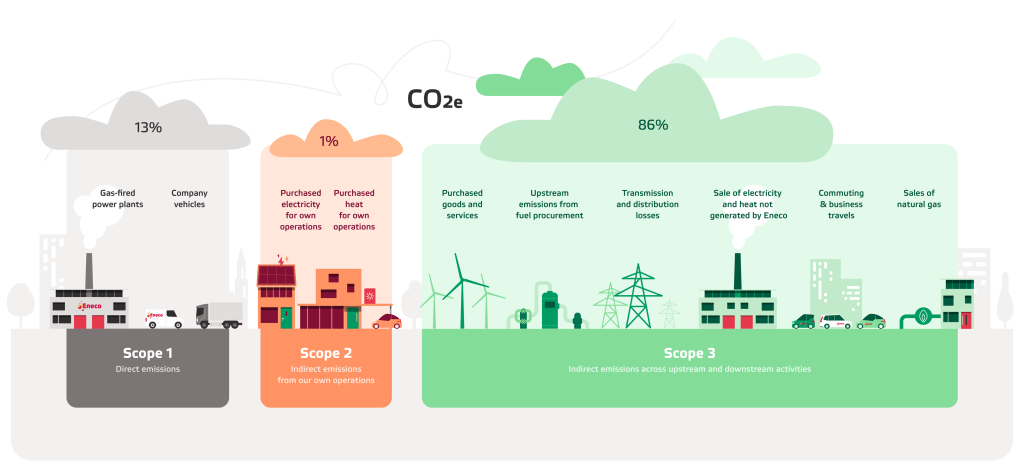
Eneco reports its emissions in accordance with the GHG Protocol Corporate Standard, an international standard that covers the accounting and disclosure of emissions by organisations. Under this standard, greenhouse gases are categorised in three scopes, based on their source.
- Scope 1 – Direct emissions
Emissions from own or managed sources (e.g. plants, vehicles and processes). - Scope 2 – Indirect energy-emissions
missions from purchased energy (e.g. electricity consumption in buildings). - Scope 3 – Other indirect emissions
Emissions in the value chain (e.g. production, transport and use by customers).
For scope 3, Eneco reports in accordance with the GHG Protocol Corporate Value Chain (Scope 3) Accounting and Reporting Standard, which is an addition to the Corporate Standard. The reporting is based on relevant legislation and international standards, including EU and Dutch legislation, CSRD, the GHG Protocol and SBTi.
Eneco's decisions and interpretations are recorded in the N.V. Eneco Greenhouse Gas Accounting Manual (PDF). This document describes the accounting policies, methodology and disclosures for measuring, processing and publishing emissions for external reporting. Avoided emissions are discussed according to the guidelines of the World Business Council for Sustainable Development (WBCSD).
Climate actions
We can only achieve our climate ambitions if we do this together with customers, the local community, and local partners such as residents, municipalities, housing corporations, and energy cooperatives. Together with them, we are working on affordable solutions, social innovations and new participation models to distribute the benefits and burdens of energy transition fairly and make them more transparent.
We put all our efforts into three climate actions:
How are we going to do that?
To accelerate becoming climate neutral, we are focusing on:
Decarbonise our customers
- 100% green electricity
- Alternatives for heating with natural gas like (hybrid) heat pumps, (small scale) heat networks and green gas such as biomethane, and green hydrogen (for industry)
- Decarbonising mobility with electric charging
Generate more sustainable energy
- More green electricity: feeding heat pumps, electric vehicles, etc. from solar panels and windfarms. Includes conversion or closure of non-renewable capacity
- Green heat production for our heat networks, e.g. using aquathermal or geothermal energy
- Green molecules such as biomethane and green hydrogen
Balance and optimise the energy system
- Develop or contact CO₂-free flexible assets, like utility scale batteries, e-Boilers and heat buffers
- Unlock flexibility in assets, such as heat pumps, electric vehicles and solar and wind farms by bundling them in Virtual Power Plants